Dynamic branding: a new system for relevance and reach
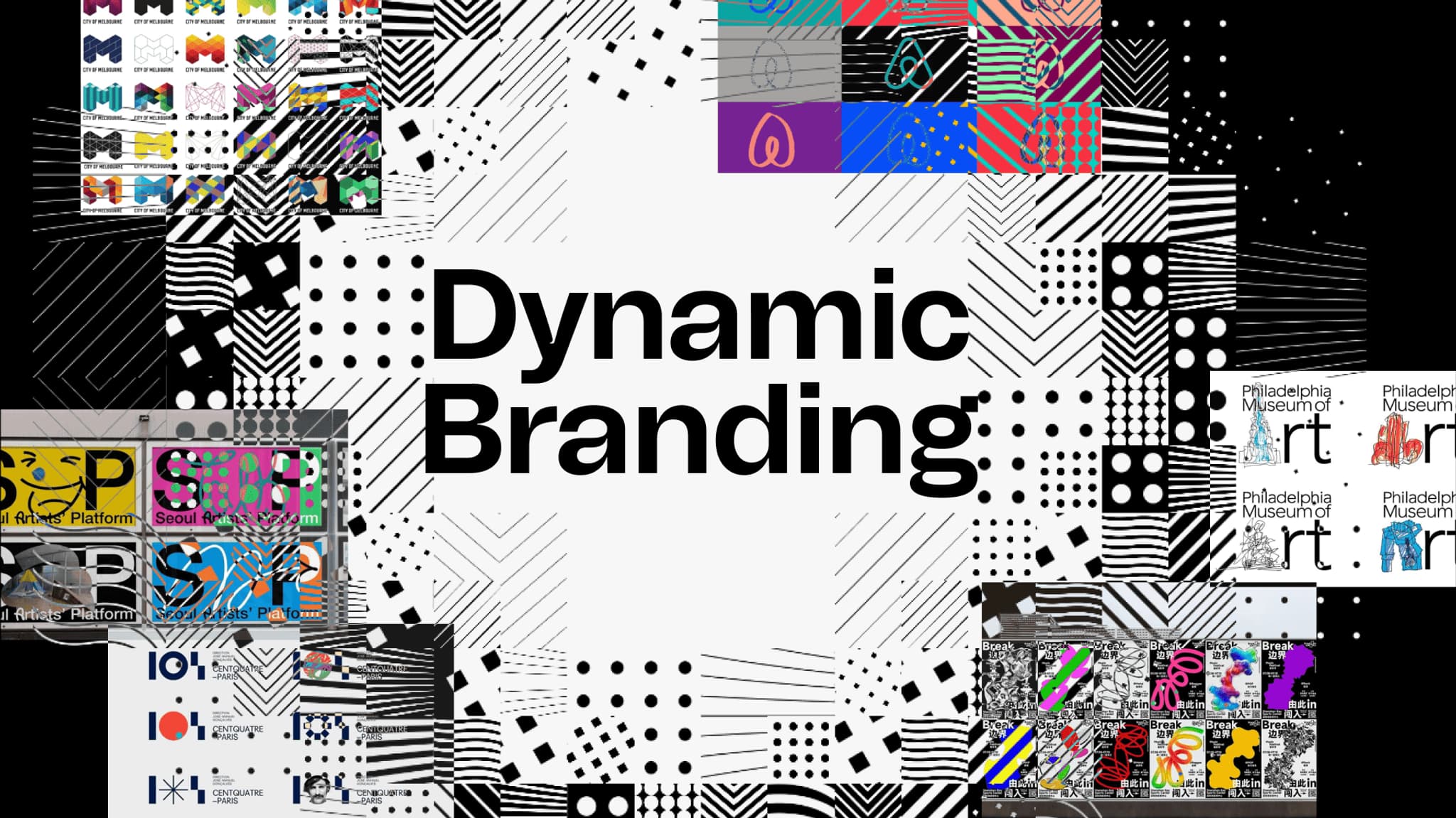
Summary
While brands were once primarily defined by static logos, a new wave of successful brands is emerging.
While brands were once primarily defined by static logos, a new wave of successful brands is emerging.
These brands are agile, navigating the digital landscape and connecting authentically with different audiences. Dynamic branding isn't about changing who you are. It's about revealing different facets of your brand's personality, just like a skilled performer adapts their act for different audiences. One moment, you're professional and precise; the next, you're playful and provocative. Like a chameleon that blends in while standing out.
Dynamic branding offers a solution: adaptability while maintaining a consistent brand core.
1. What exactly is dynamic branding?
Dynamic branding isn’t just a buzzword; it’s a strategic approach to brand evolution. Think of it as a jazz performance, improvising and adapting, but always staying true to its melody.
Let’s break down the core concepts to clarify what dynamic branding encompasses:
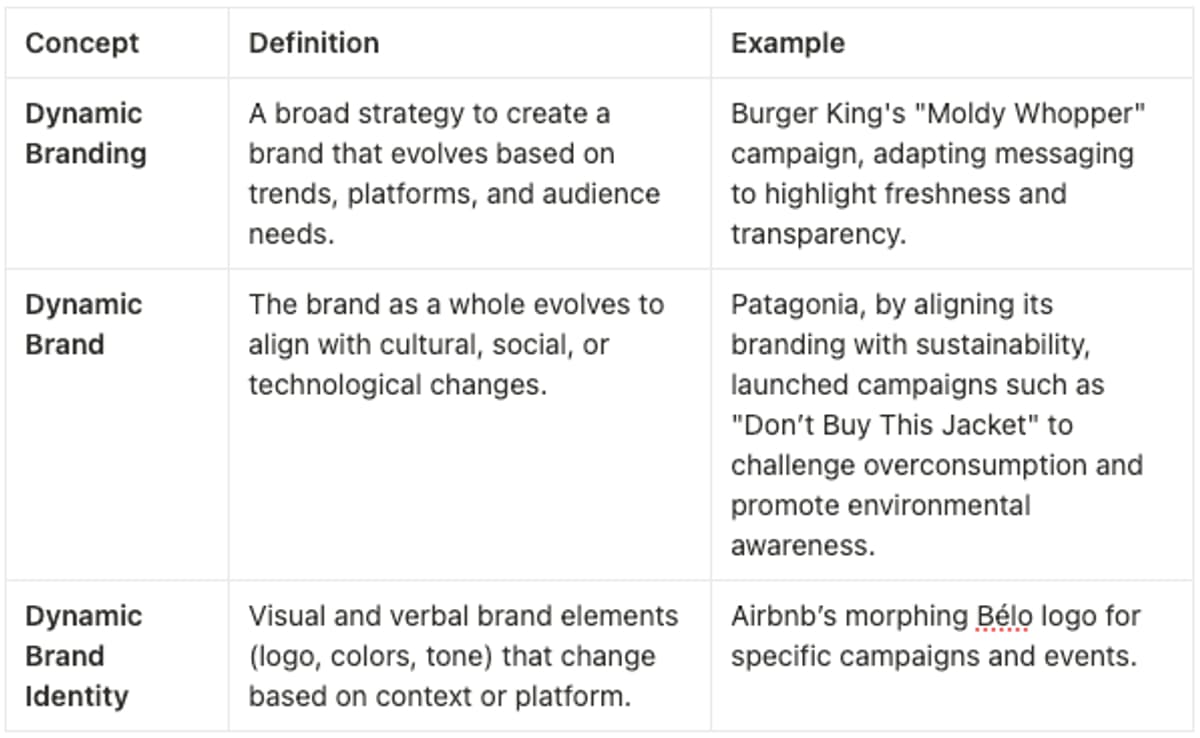
Please note that dynamic branding isn’t just about personalizing products or tailoring user experiences. It extends to how a brand adapts its visual elements, messaging, and overall approach to resonate with different contexts and audiences. At its core, dynamic branding leverages real-time data and specific situational cues to create meaningful, deeper connections with diverse target groups.
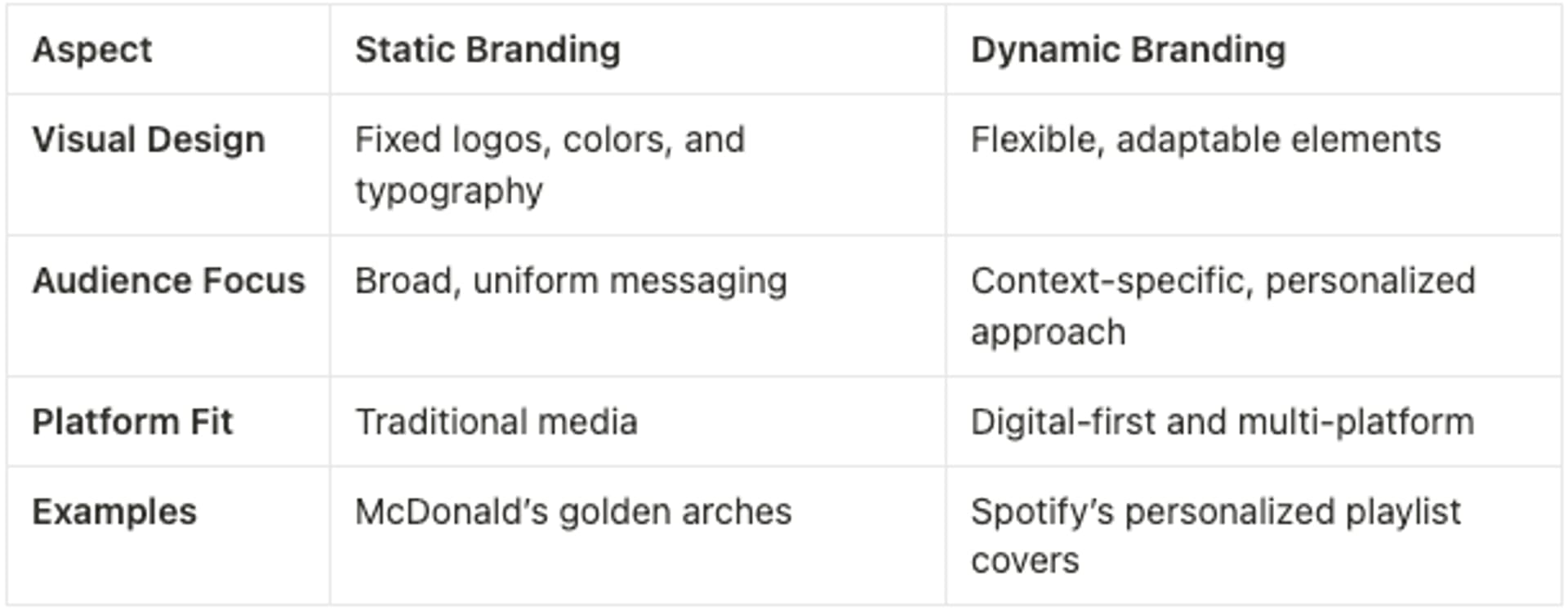
Dynamic Branding vs. Static Branding
Dynamic branding differs fundamentally from static branding, which has been the go-to approach for decades. Here’s how they compare:
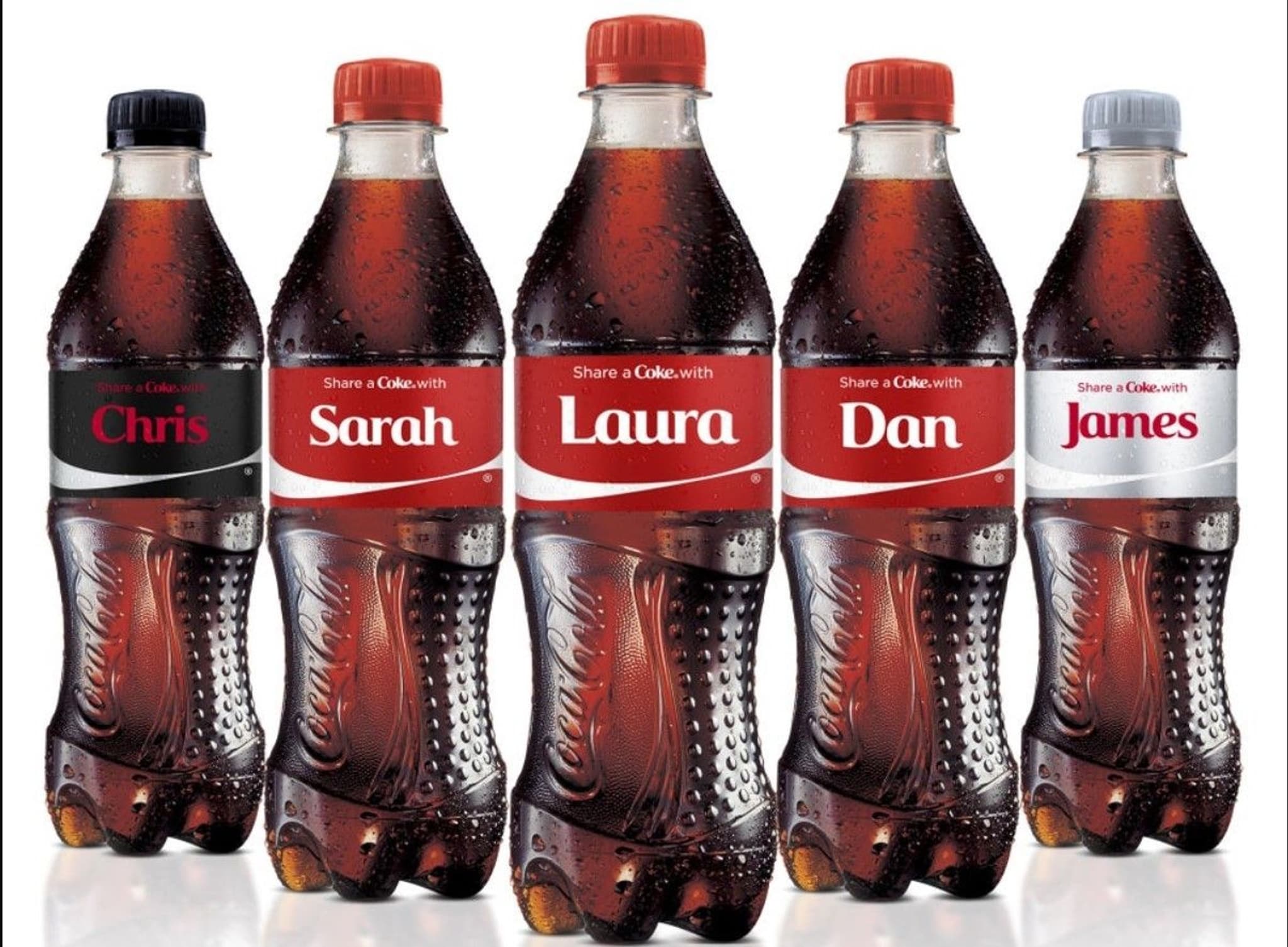
Coca-Cola: Static vs. Dynamic Branding
Coca-Cola’s static branding is characterized by its timeless red-and-white logo, classic typography, and signature bottle shape. These elements remain consistent across all markets and traditional media, creating a universal and instantly recognizable identity. For example, Coca-Cola’s TV ads and billboards often rely on these core visuals to evoke nostalgia and trust.
In contrast, Coca-Cola’s dynamic branding emerges in campaigns that adapt to specific audiences or contexts. The “Share a Coke” campaign replaced the iconic logo with individual names and phrases, creating a personalized experience that resonated globally. Similarly, during the FIFA World Cup, Coca-Cola incorporates national flags and cultural themes into its designs, making its branding locally relevant. These dynamic adaptations help Coca-Cola engage more deeply with modern, diverse audiences.
2. Why your business needs dynamic branding
Dynamic branding isn't a trend, it's a survival strategy for businesses. This approach gives brands the power to adapt, connect, and lead by transforming their identity without losing their core essence.
Your brand becomes more than a logo or a color palette. It becomes a living, breathing entity that speaks directly to audiences, anticipates market shifts, and stays consistently relevant. Dynamic branding lets you turn change from a threat into a strategic advantage.
a. Stronger engagement and awareness
In an age of infinite scroll and visual saturation, grabbing attention is no longer about being louder, it’s about being more alive. Dynamic branding, when done right, creates visual motion and meaning that disrupts passive viewing.
Airpen, an AI illustration startup, built its brand identity around the very concept it sells: intelligent creativity. Its logo system isn’t static; it shifts form and tone depending on context, from abstract, generative art shapes on the website to expressive, stroke-based logos on social. This fluidity makes the brand inherently engaging. The identity becomes a demonstration of the product itself, reinforcing value through form. In a crowded AI ecosystem, Airpen doesn’t just say it’s creative, it shows it.
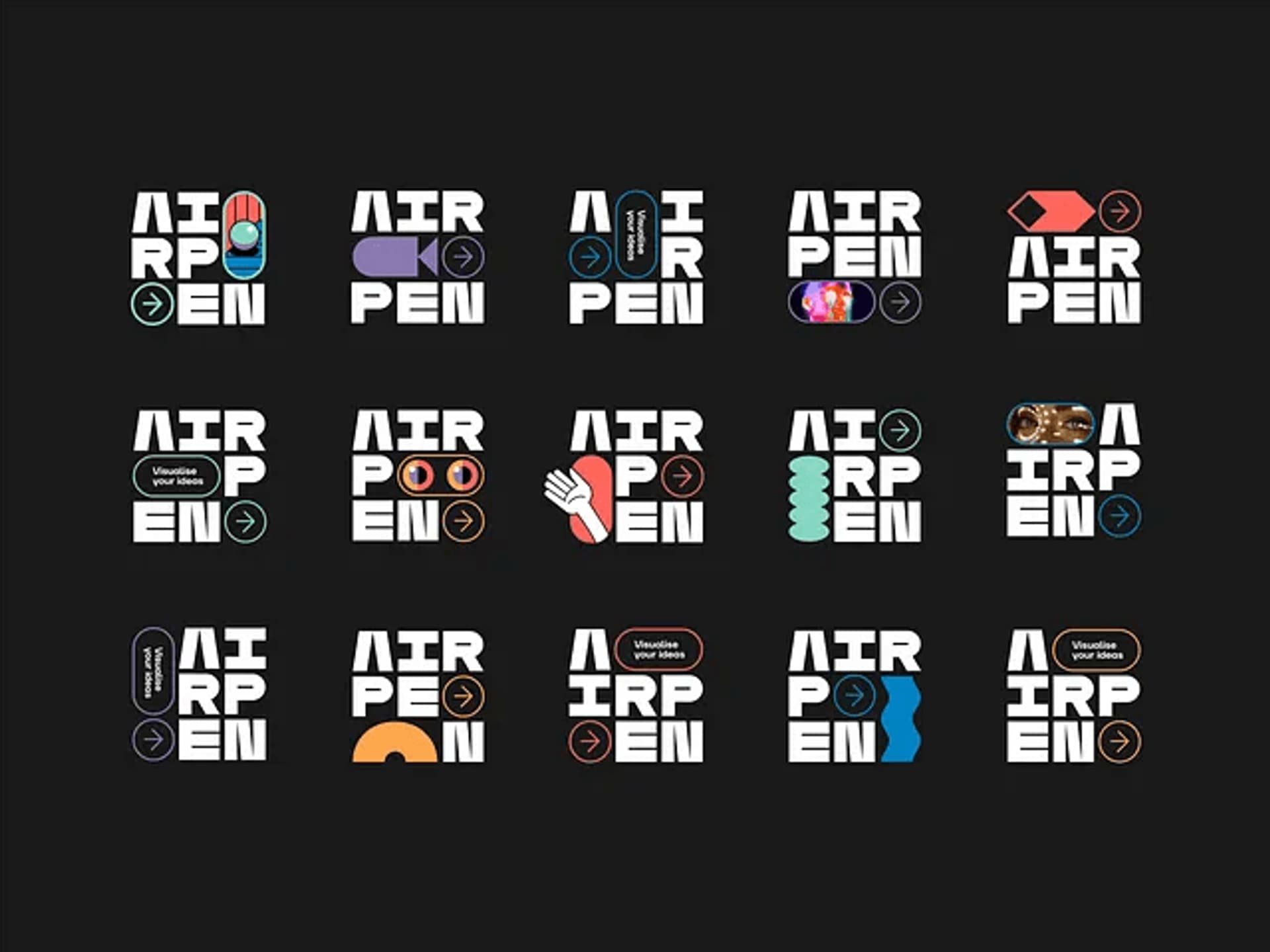
Strategic Insight: A dynamic identity system can act as a perpetual campaign, renewing attention, inviting interaction, and building awareness by design.
b. Deeper Emotional and Personalized Connection
Today’s premium customers expect more than quality - they expect to be known. Dynamic branding, especially when paired with AI, enables a level of real-time intimacy that static systems simply can’t reach.
Across leading retail platforms in 2025, we’re seeing hyper-personalized brand interfaces that greet users by name, shift product recommendations based on weather, mood, or time of day, and adapt visuals to match previous behaviors. These aren’t just product tweaks - they’re expressions of a responsive brand personality. The system flexes to reflect the user, making them feel seen and valued.
Strategic Insight: When personalization becomes part of your brand’s visual and verbal behavior, it stops being a feature, and becomes a bond.
c. Greater flexibility in building brand narrative
A modern brand is not a fixed story, it's a layered narrative unfolding across time, culture, and audience. Static systems restrict this evolution. Dynamic branding creates space to speak in multiple voices, while remaining unmistakably “you.”
Google’s playful Doodles, replacing its homepage logo to honor global events, local festivals, or cultural icons, are a textbook example of narrative agility. While the underlying wordmark stays the same, the outer layer adapts constantly, reflecting moments that matter to its users. From Lunar New Year to LGBTQ+ history to obscure inventor birthdays, Google becomes a storyteller without ever saying a word.
d. Consistency across channels (with adaptability)
The most successful brands today are omnipresent, from in-store to app, billboard to Web3. But presence without coherence leads to fragmentation. A dynamic brand system solves this by building adaptability into the core ruleset.
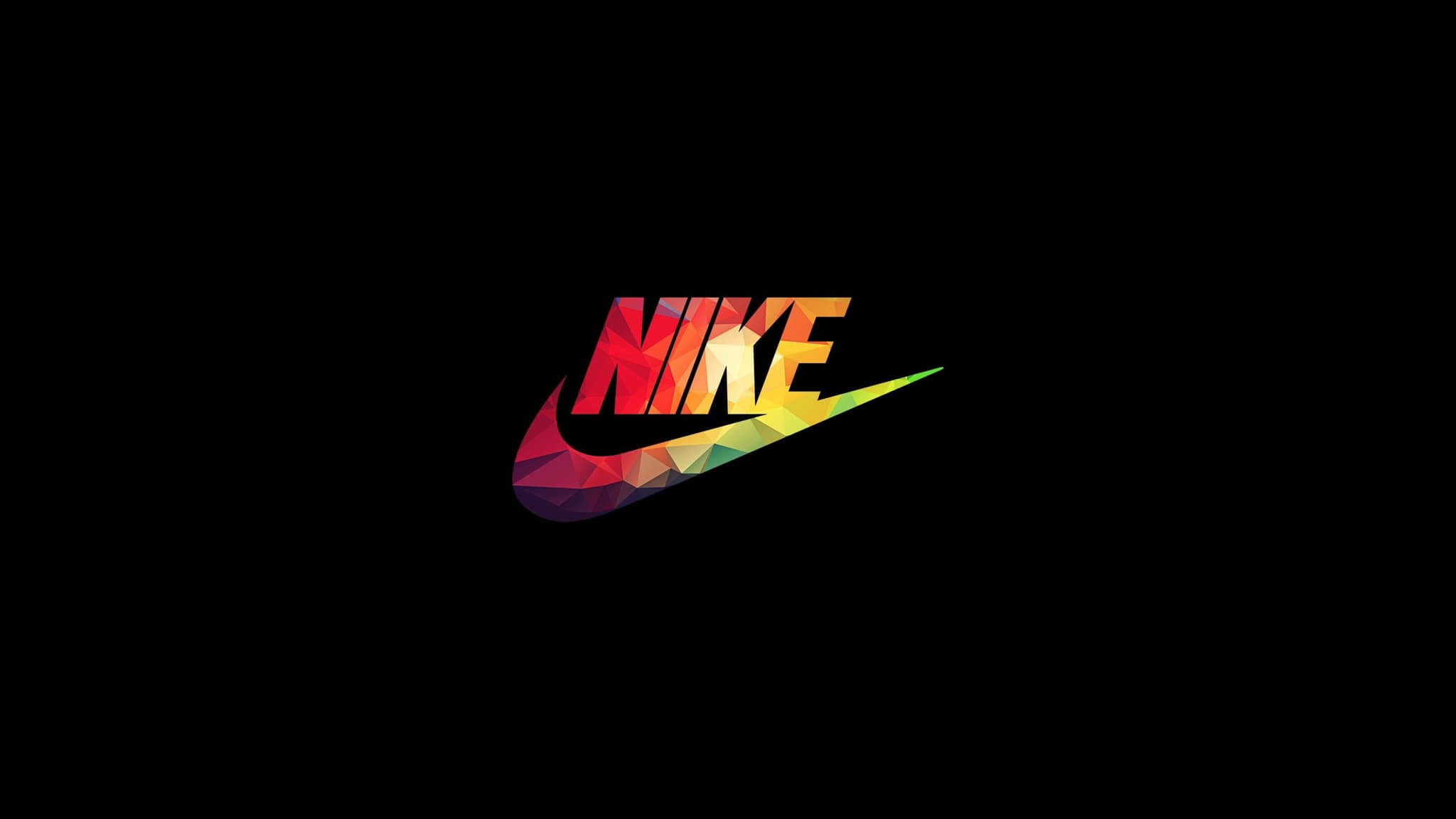
Nike’s iconic Swoosh isn’t just a mark, it’s a canvas. Whether appearing in bold pink for Breast Cancer Awareness Month, rendered in metallic 3D for athlete campaigns, or integrated subtly into fashion collabs, the Swoosh morphs contextually while remaining instantly recognizable. This adaptability allows Nike to flex tone, message, and medium while keeping brand recognition intact across thousands of touchpoints.
Strategic Insight: Adaptability doesn’t weaken consistency, it defines it. In dynamic systems, coherence is designed, not assumed.
e. Cultural responsiveness
Culture moves fast. For global brands, the ability to recognize, respond, and reflect cultural contexts, without generic tokenism, is critical. A dynamic identity makes this responsiveness strategic rather than reactive.
Coca-Cola has long mastered the balance of global consistency and local resonance. During events like the Olympics or the World Cup, the brand dynamically adapts visual elements, typography, language, flag motifs, to align with national pride or regional values. Their Arabic calligraphy logo for Middle Eastern markets, or localized packaging during Tet in Vietnam, show how a dynamic system can carry universal values while expressing them through local design codes.
Cultural agility builds trust. Dynamic branding gives you the design vocabulary to speak fluently across regions and moments.
3. Strategic value: flexibility with cohesion
In a fragmented brand landscape, cohesion is no longer about being rigid, it's about being intentional. Dynamic branding isn’t just about having a flexible visual identity; it’s about embedding strategic elasticity into the DNA of your brand, so that every new expression, no matter how adaptive, still reinforces your core essence.
Why cohesion matters more than uniformity
At the strategic level, dynamic branding’s greatest strength is enabling agility without chaos. It gives brand managers a framework to respond in real time while maintaining unity. The goal is that any variation still feels like the same brand. Pentagram’s Scher explains: “If you go to the Public Theater and see their website, Twitter button, etc., you’ll see it’s completely connected. No matter how you see it, you always know it’s the Public”.
Traditional brand systems focused on repetition: the same logo, same layout, same color, everywhere. But in today’s world of algorithmic feeds, diverse audiences, and multi-platform storytelling, uniformity often translates to invisibility. Consistency now demands a deeper kind of coherence: not visual sameness, but conceptual unity. A brand needs to look different, feel relevant, and still be instantly recognizable - across every touchpoint.

The new standard: designed variability
What dynamic branding enables is variability by design. You establish what must remain fixed - logo form, typography, core color values, tone of voice - and what can flex: layout systems, motion language, campaign-specific elements, cultural motifs. This controlled flexibility is what gives modern brands longevity. It’s not about change for the sake of change, it’s about building a system that evolves purposefully.
Leverage technology for personalization
To scale dynamic branding efforts, brands must embrace emerging technologies that enable deeper personalization. AI-powered tools allow brands to analyze customer data and tailor experiences in real-time, ensuring that every interaction feels uniquely relevant to the individual. Additionally, Augmented Reality (AR) offers innovative ways to engage customers by blending the physical and digital worlds, enabling personalized, immersive experiences that resonate on a deeper level. By integrating these technologies, brands can enhance their adaptability, creating more meaningful, customized interactions that evolve with their audience’s needs and preferences.
4. The future is fluid
In a world where brands are expected to respond in real-time, to social conversations, market shifts, product updates, or cultural movements, dynamic branding gives you the tools to act without unraveling. You don’t need a redesign for every campaign or a different logo for every channel. Instead, you operate from a unified, expandable system that supports growth, speed, and relevance.
This is especially critical for high-end brands that balance heritage with innovation. You must show consistency to build trust, yet show evolution to stay desirable. Dynamic branding resolves that tension. It lets you speak in many tones while always sounding like yourself.
Want to make your brand future-ready? Let's talk.
The future is fluid. Your brand can be too.