Design is not strategy, but it cannot live without it

Summary
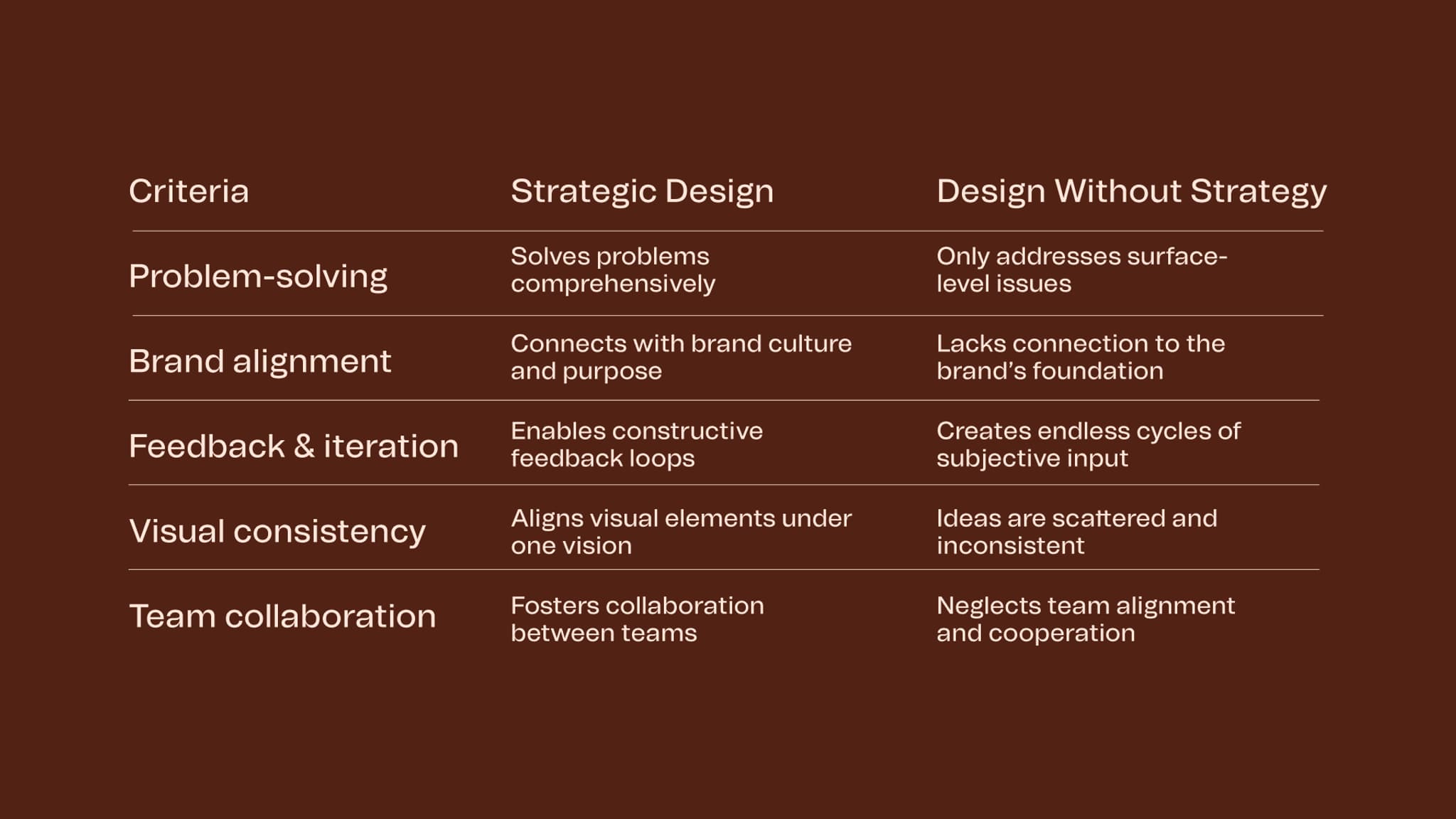
Design without strategy creates activity without direction. CDA argues that strategy gives creativity a meaningful problem, a point of view, and a standard for decisions, so design can stay useful beyond the first presentation.
Strategy gives creativity a meaningful problem
Design becomes useful when it is connected to a clear problem, a human tension, and a decision the organization needs to change. Strategy gives the work that direction without prescribing its final form.
This article challenges the idea that creative freedom means working without context. It shows how strategy, constraints, criteria, and systems help design carry meaning beyond the first presentation.
Design is not strategy, but it cannot live without it
Design is often asked to solve a problem that has never been decided. Make us look more modern. Make this feel premium. Make people understand us. Without a clear direction, every visual choice becomes a proxy for a debate the organization has avoided.
Strategy gives creativity a consequential problem. Design makes the resulting choices visible, usable, and memorable. Our view at CDA is direct: design without strategy can produce activity, but it cannot reliably produce meaning.
The blank page is not freedom
A blank page gives a team no reliable way to distinguish an interesting direction from a useful one. Feedback becomes personal. Reviews become taste contests. The work changes with every new opinion.
A real audience, a specific tension, and a clear promise create the pressure that allows an idea to become distinct. Creativity needs room to explore, but it also needs a problem worth solving.
Strategy is more than the deck beside the design
A strategy document can be useful, but strategy is the pattern of choices that the document makes visible. If the creative team cannot use those choices to evaluate an idea, the strategy has not reached the work.
If the brand wants to reduce uncertainty, the interface, language, and hierarchy should help people know what happens next. If it wants to make expertise approachable, the identity should not rely on insider codes. The design is not an illustration of strategy. It is one of the places where strategy becomes real.
Find the decision behind the design request
Before developing concepts, ask what decision the work needs to change. Does a buyer need to choose between similar offers? Does a team need a shared way to explain its value? Does a new business need to be understood in a category that has trained people to expect the same language?
Then identify the cost of leaving the decision unresolved. People may delay, default to the familiar, ask for more proof, or choose on price alone. Design has leverage when it works on the condition behind the request.
Make constraints useful instead of hiding them
Bring budget, accessibility, technical limits, legal requirements, internal capability, and rollout conditions into the creative problem early. Ask what the idea needs to survive and what must remain clear when the original team is no longer present.
A constraint can reveal the idea. If the promise must be understood in a few seconds, what is essential? If the system must stretch across teams, which principle should remain recognizable? Limits are generative when they help the team choose what deserves to endure.
Replace taste with criteria that people can use
Taste will always matter in design. It is part of judgment, not a substitute for it. Agree on criteria before the options arrive. The work should be recognizable, relevant to the audience’s situation, coherent across touchpoints, usable in practice, and adaptable as the context changes.
These criteria do not eliminate disagreement. They improve its quality. A direction can be beautiful and still be wrong for the problem. A quieter direction can be strategically stronger.

Design must survive the handoffs around it
A design system is experienced through handoffs: strategy to concept, concept to production, marketing to sales, product to support, and leadership to the teams who maintain the work. Each handoff can preserve meaning or flatten it.
A visual identity is not finished when the files are delivered. The people using it need to understand the decisions behind it. Good design gives teams principles, examples, and enough flexibility to act without asking for permission at every turn.
Form carries a promise about how the organization behaves
Every design choice makes an implicit promise. A clear hierarchy promises that the organization respects people’s attention. A calm interface promises that the next step will be understandable. A distinctive identity promises that the company has a point of view rather than a collection of borrowed signals.
Those promises create expectations the wider system must meet. If the service contradicts the identity, the problem is not solved by making the identity louder.
A working design strategy connects four choices
When we audit a design direction, we look for a connection between four choices:
- Meaning: what should people understand?
- Behavior: what should people do, and what should the organization make easier?
- Expression: what patterns make the meaning recognizable?
- Continuation: how will the system stay useful as context changes?
Meaning without behavior becomes a statement. Behavior without expression becomes invisible intention. Expression without meaning becomes decoration.

Ask these questions before opening the canvas
Before the first concept, a team should be able to answer: What is the real problem in human terms? Which decision should become easier? What belief does the organization need to make credible? What must the design protect when different teams use it? What should the work deliberately avoid looking or sounding like?
These questions give exploration a place to start and a way to return when the work becomes complicated.
Define success as evidence, not applause
Creative work can feel successful because it receives enthusiasm in a room. That response matters, but it is not enough. Agree on the signals that will show whether the work addressed the problem.
Some evidence is behavioral: a clearer choice, a completed action, a better conversation, or fewer avoidable questions. Some is organizational: teams use the same story and can deliver the promise without special handling. Taste remains part of the judgment, but it should not be the only form of evaluation.

A design system should become a shared capability
The organization should not need the original designer in every room to keep the work coherent. People need to understand the principles behind the system, the decisions those principles protect, and the room they have to adapt the expression.
Documentation, examples, templates, language guidance, and governance are not administrative extras. They let the design move through the organization without losing its purpose.
Design has to anticipate the next condition
A system that works only at launch is unfinished. New products arrive, teams change, channels multiply, and audiences bring different expectations. The identity needs enough stability to be recognized and enough flexibility to remain useful.
Ask what should stay constant and what can change. The answer is rarely a fixed set of visual rules. It is usually a principle about the relationship between the brand and the people it serves.
Make the system legible to the people who use it
Design becomes stronger when the people who carry it forward can see how it works. They need to know which elements are essential, which decisions are flexible, and what the system is trying to make easier.
Explain the reasoning in plain language. A rule that cannot be understood becomes a dependency on the original team. A principle that can be understood becomes a shared capability. The goal is not to control every expression. It is to help people make responsible choices without losing the central idea.

Test the problem before testing the idea
Read the design brief as if you had never attended the project meetings. Can you tell what is changing, for whom, and why now? Can you explain the tension without internal language? Can you name the choice the work needs to influence?
If you cannot, keep working on the framing. More visual options will not create the missing decision. A clear problem is not a restriction on design. It is the condition that lets design be judged fairly.
Make review a conversation about consequence
Ask reviewers to describe what each direction makes clearer, possible, or harder. Which promise does it strengthen? Which audience does it serve? What behavior does it invite? What does it assume the organization can deliver?
This moves critique away from preference without pretending that preference disappears. A strong review makes the consequences of a choice visible, so the team can decide with more care.
Know when the design is solving the wrong problem
Sometimes the right outcome of a design process is to stop designing. If the offer is unclear, the audience is contested, or the organization cannot keep the promise, more expression will only make the uncertainty look finished.
Return to the tension, the decision, and the proof required. The design can move again when the conditions are honest enough to support it.
Design needs leadership to carry its consequences
Leaders decide whether a design idea remains a presentation or becomes a way of working. They allocate attention, resolve trade-offs, and protect the promise when short-term pressure asks for a cheaper or louder answer.
Without that support, even a strong system becomes decoration around unchanged decisions. With it, design can improve the relationship between what the organization says and what people experience.
Strategy gives creativity somewhere to go
Design does not need strategy because strategy is more important than design. It needs strategy because form has consequences. What people see, hear, and use changes what they believe is possible and what they expect the organization to do.
A clear strategy gives the creative team a meaningful problem and gives the organization a fair way to judge the answer. It lets the work be distinctive without becoming arbitrary, and disciplined without becoming dull.
Start with the choice that matters
The most useful design question is rarely “What should this look like?” It is “What should become easier to understand, choose, or believe?” That question connects the visible work to a real human and organizational consequence.
Once the choice is clear, the team can explore with more freedom because it knows what the work must protect.
Make the design strong enough to be useful
Strategy should not flatten creativity into a checklist. It should give creativity somewhere to land. Design then gives strategy form, behavior, and memory.
Begin with the problem, name the tension, decide what matters, and build a system that can carry the promise. That is how creativity becomes more than activity.